Traumatic Brain Injury Support: How ICWP Helps Adults in Georgia

The hardest part usually isn't the hospital. It's the month after.
Inpatient rehab has a discharge date. Insurance has a visit cap. And then a family drives home with someone who looks like the person they were before — but who can't reliably remember to take a medication, gets lost in the middle of a familiar sentence, or becomes exhausted and irritable by two in the afternoon. The medical crisis is over. The disability is just beginning.
Georgia has a Medicaid program built specifically for that stretch of the road. The Independent Care Waiver Program (ICWP) is one of only a handful of state waivers in the country that names traumatic brain injury as its own qualifying condition, alongside severe physical disability. This guide walks through what that actually means for an adult living with a TBI, and for the family holding it together.
Why TBI Has Its Own Door in ICWP
Most Medicaid long-term care programs are built around physical need: can you transfer, bathe, dress, walk. A brain injury doesn't always show up on that checklist. Someone with a moderate TBI may be able to physically walk to the kitchen and physically open a pill bottle — and still be genuinely unsafe living alone, because the injury took initiation, judgment, or short-term memory instead of strength.
ICWP recognizes this in a specific and important way. The program serves adults with a severe physical disability or a traumatic brain injury that substantially limits one or more activities of daily living and requires the assistance of another person.
And there's a distinction inside the rules that matters enormously for brain injury families:
Most ICWP applicants must be capable of directing their own services. Applicants with a traumatic brain injury are not held to that requirement. The program was written to accommodate the cognitive reality of brain injury, not to screen it out.
That single carve-out is why ICWP is often the right door for a TBI survivor when other waivers aren't.

Who Qualifies
To be approved for ICWP, an applicant generally must:
- Be between 21 and 64 at the time of application. Participants approved before 65 can stay enrolled past 65 as long as they continue to meet the other criteria. Adults over 65 applying for the first time are typically routed to EDWP instead.
- Be eligible for Georgia Medicaid. ICWP is a Medicaid waiver, so Medicaid eligibility comes first. If that piece isn't in place yet, it can be pursued in parallel.
- Meet a hospital or nursing facility level of care. This is the heart of a waiver: the state agrees to pay for care at home because the alternative would be an institution.
- Be medically stable but genuinely at risk of that placement.
- Be able to be served safely in a home or community setting.
A common misconception is that "nursing facility level of care" means someone must be bedbound. It doesn't. For TBI, the level-of-care finding often rests on supervision needs, safety risk, behavioral or cognitive impairment, and the need for cueing throughout the day — not on physical dependency alone. Documentation from a physician, neuropsychologist, or rehab team describing those needs in concrete terms carries real weight in the assessment.
What ICWP Actually Covers
Once enrolled, ICWP funds a package of services built around the participant's plan of care. Covered services include:
- Personal support services — hands-on and cueing assistance with bathing, dressing, grooming, meals, medication reminders, and daily routines
- Skilled home health services — nursing visits, and therapy where medically necessary
- Specialized medical equipment and supplies
- Counseling services — including support for adjustment, behavior, and family coping
- Emergency response systems — the personal alert devices that make living alone or being alone for stretches of the day realistic
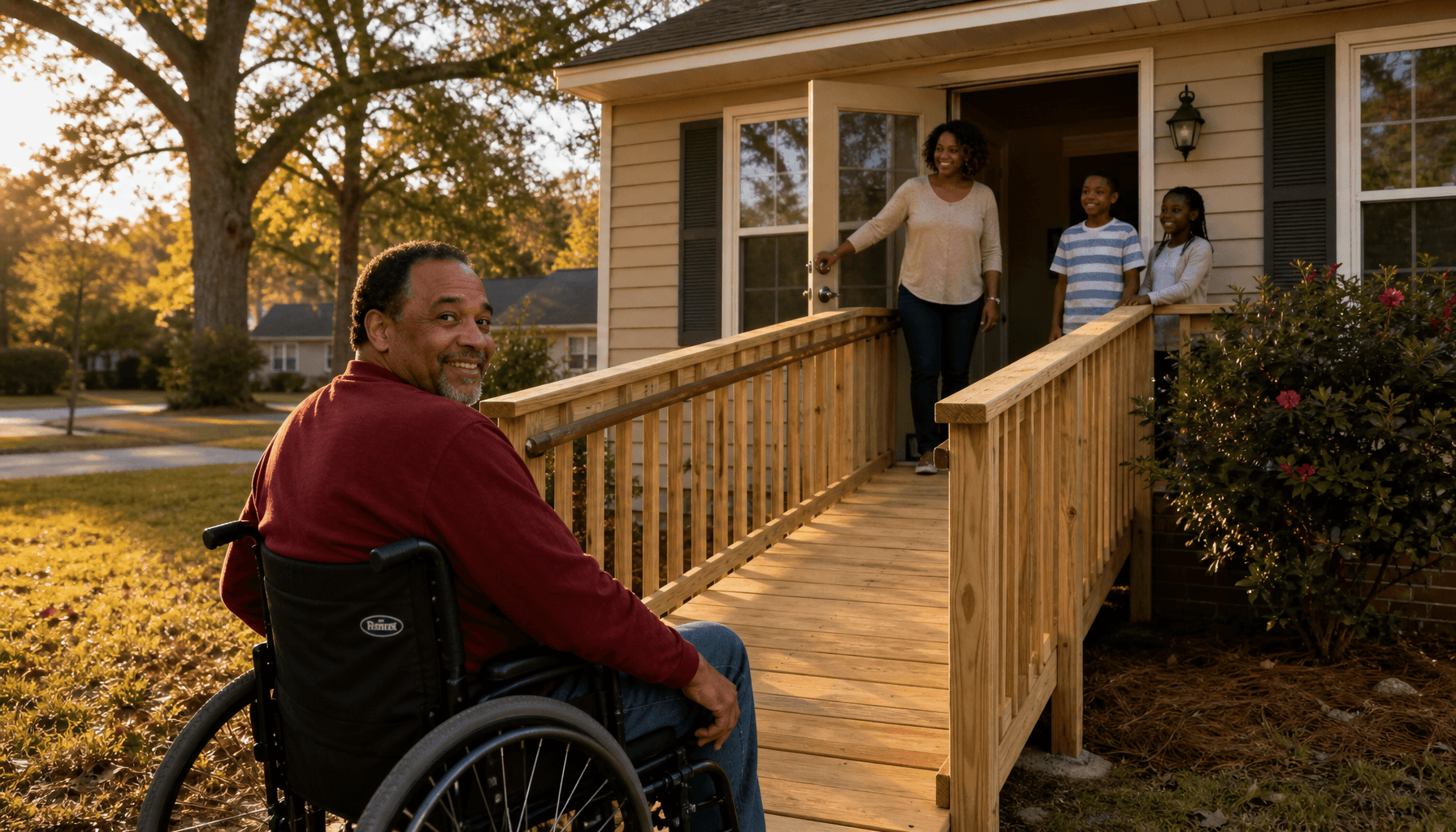
- Home modifications — ramps, bathroom accessibility, grab bars, and similar changes (covered in depth in our post on ICWP environmental modifications)
- Adult day health — structured daytime programming, which for TBI often doubles as routine, social contact, and caregiver relief
- Home delivered meals
- Personal care home placement and 24-hour medical access for participants who need them
For brain injury specifically, the services that tend to change a family's life most aren't the dramatic ones. They're the daily structure: a consistent aide who arrives at the same time, prompts the same routine, and notices when something is off.
How to Apply
ICWP applications are handled through Alliant Health Solutions, the state's contracted assessment organization (long known to Georgia families as GMCF).
- Alliant Health Solutions: 1-888-669-7195
- Georgia Medical Care Foundation line: (800) 982-0411
- Email: HCBSWaivers@AlliantHealth.org
The process runs roughly like this:
- The intake call. Someone asks a set of screening questions about the injury, current function, living situation, and Medicaid status. A family member or representative can make this call.
- The application. Paperwork is submitted, including medical documentation supporting the level-of-care finding.
- The in-person assessment. An assessor visits the home and evaluates functional and cognitive needs directly.
- The waiting list. This is the part no one likes hearing.
Be Honest With Yourself About the Waiting List
ICWP serves a limited number of slots, and services are provided as funding becomes available. Approval and enrollment are not the same day. Wait times vary and can be long.
Two practical implications:
- Apply early, even if today feels manageable. The worst version of this is calling for the first time from a hospital discharge planner's office. Time on the list is itself a factor in prioritization.
- Don't wait idly. Georgia Medicaid state plan services, private insurance benefits, and community programs can bridge the gap. A good provider or care navigator will help you assemble that bridge rather than telling you to sit tight.

The Other Georgia Resource Most Families Miss
Separate from Medicaid entirely, Georgia funds the Brain and Spinal Injury Trust Fund Commission (BSITFC) — the state's only agency dedicated specifically to traumatic brain and spinal cord injury. It issues direct grants for post-acute care and rehabilitation.
Grants can cover transportation, assistive technology, durable medical equipment, personal support, cognitive and physical and occupational and speech therapy, counseling, and neuropsychological testing.
To qualify, a person must be a legal Georgia resident with a physician's letter or hospital record documenting a traumatic brain or spinal cord injury, caused by a fall, being struck by or against something, an assault, a self-inflicted injury, a sports or recreation injury, or a motor vehicle accident.
The Commission also staffs TBI Resource Facilitators who help families navigate options at no cost:
- TBI Resource Facilitator: 404-556-2528
- Commission office: 404-651-5112 or toll-free 888-233-5760
If you take one action item from this article, make it this: call a resource facilitator while your ICWP application is pending. The Trust Fund can often move faster than the waiver waiting list.
If ICWP Isn't the Right Fit
Not every brain injury leads to ICWP. Depending on age, cause, and diagnosis, a different program may be the better door:
- If the injury occurred before age 22 and resulted in an intellectual or developmental disability, the NOW and COMP waivers may apply
- If the person is 65 or older, EDWP through CCSP or SOURCE is generally the path
- For medically fragile children and young people under 21, GAPP provides in-home skilled nursing
These programs don't overlap much, and a person can generally only be enrolled in one waiver at a time. Getting the right door on the first try saves months.
A Word for the Family
Brain injury is often called an invisible disability, but inside a household it is anything but. Families describe grieving someone who is still sitting across the table. They describe becoming a full-time supervisor, scheduler, and safety net, usually while still working.
ICWP will not undo the injury. What it can do is put trained hands and structured hours into the home, so the family can go back to being family instead of being unpaid staff. That shift is real, and it is worth the paperwork.
If you're caring for a Georgia adult living with a traumatic brain injury and you're not sure where to start, start with a phone call. Ask about ICWP. Ask about the Trust Fund. Ask what can happen while you wait. There is more available than most families ever hear about.
Ready to Get Started?
Contact Heart and Soul Healthcare today to learn how our programs can support you or your loved one.