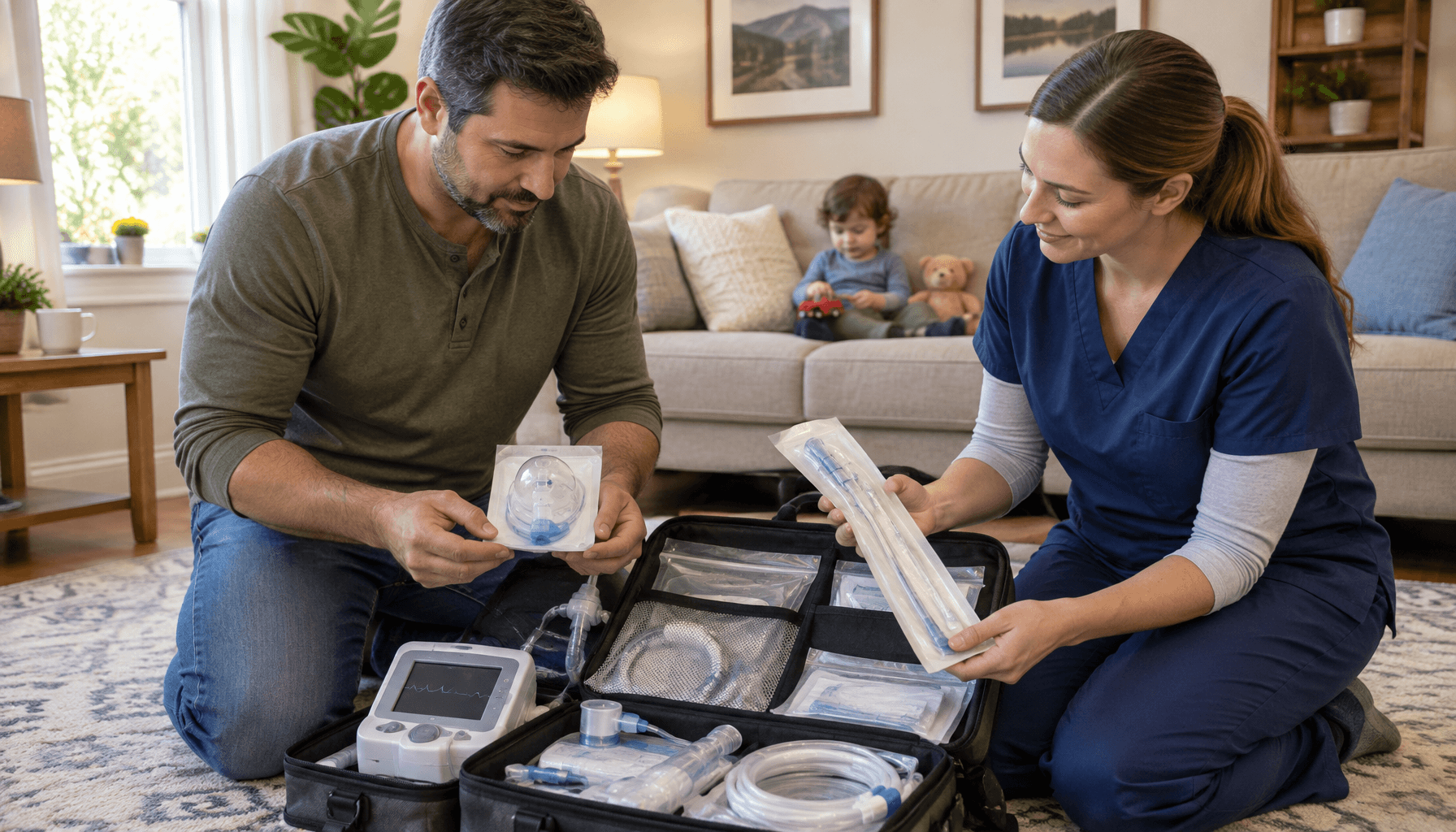
How Many GAPP Nursing Hours Can a Child With a Trach or Ventilator Get?

"How many hours will we get?" is usually the first question a family asks once a child with a trach or ventilator is headed home. It is a fair question. The hours decide whether a parent can sleep, keep a job, or care for the other children in the house.
The honest answer is that there is no set number. Under the Georgia Pediatric Program (GAPP), nursing hours are approved one child at a time, based on that child's medical needs. This guide explains how the decision is made, so you know what drives it and what you can do to make sure the request reflects your child's real needs.
Who Decides the Hours
GAPP is run by the Georgia Department of Community Health. The state contracts with a medical review team to decide which children qualify and how many hours each child is approved for.
The request starts with your child's physician. GAPP requires a Physician Plan of Treatment, signed by the doctor, that spells out the skilled nursing your child needs and the hours the physician recommends. The nursing agency builds the rest of the packet around those orders and submits it. Reviewers then look at the whole picture and approve, reduce, or deny the hours requested.
Under the October 2026 GAPP manual, reviewers have seven days to decide once they have a complete packet. Incomplete packets are the main cause of delay, and a packet that stays incomplete for 30 days is withdrawn.

What Drives the Number
Reviewers base the hours on medical necessity. For trach and vent children, these are the factors that usually matter most:
- How much skilled care the airway needs. How often your child needs suctioning, how thick the secretions are, and how stable the airway has been.
- Ventilator dependence. Whether your child is on the ventilator around the clock, only during sleep, or weaning. A child who needs the vent continuously generally needs more skilled hours than one who uses it only at night.
- Other skilled needs. Many trach and vent children also have a feeding tube, seizures, or complex medications. Each of these adds to the skilled care picture.
- Recent hospital stays. Frequent admissions or a recent change in condition show reviewers that the care at home is complex.
- What the physician documents. This is the one families can influence most. A plan of treatment that describes the real day, including nighttime needs, gives reviewers what they need to see.
The manual also expects parents to be knowledgeable and competent in their child's care. GAPP nursing supports the family. It does not replace the family, so hours are approved with the understanding that parents are trained and involved.
How the Hours Work Once Approved
Approved hours come as block hours per month. The manual leaves it to the parents and the agency to decide together how best to use them. In practice, families with a trach or vent child often put most of their hours overnight, when a parent most needs to sleep, and some use daytime shifts so a parent can work. We go deeper on that choice in our post on night nursing for a child with a trach or ventilator.
How Often Hours Are Reviewed
Approvals are not permanent. The manual calls for re-evaluation at least every three to six months, and an agency cannot request more than six months at a time. A recertification request includes the last three months of nursing notes, so the documentation your nurses write every shift becomes the evidence for your child's next approval.
That is one reason the quality of your nursing agency matters. Clear, accurate notes that show what your child needed on each shift make a stronger case at renewal.
When Your Child Needs More Hours
Children's needs change. If your child's condition gets worse, or after a hospital stay, the agency can submit a change request in the middle of an approval period. Under the manual:
- A change request must be submitted within five days of the change in your child's condition.
- Reviewers decide within five days of receiving the required information.
- A request for more hours needs a physician's letter or other documentation explaining why, along with updated orders or the hospital discharge summary.
- Changes such as weaning off the ventilator or decannulation can also lead to a request, and the manual allows those to be expedited.
If hours are denied or reduced, the family is notified by certified mail and has 30 days to ask for a reconsideration.
Quick Answers
Is there a maximum number of hours? GAPP approves hours by medical need. There is no single number that applies to every trach or vent child.
Does GAPP cost the family anything? No. Approved GAPP services are covered by Georgia Medicaid at no cost to the family.
What happens at 21? Children age out of GAPP on their 21st birthday, so planning for adult services should start well before then.
Can a parent be paid for the nursing hours? No. A parent who lives with the child can be paid only for approved personal care through the Family Caregiver Option. Trach and ventilator care is skilled nursing, and every child in GAPP must have skilled nursing from the agency.

Getting the Request Right
Heart and Soul Healthcare cares for children with tracheostomies and ventilators today. We work with your child's physician on the plan of treatment, assemble and submit the GAPP packet, and keep the shift documentation that supports each renewal. A registered nurse oversees every child's care.
We serve families across metro Atlanta and surrounding counties, and families elsewhere in Georgia are welcome to reach out. Learn more about our pediatric trach and ventilator nursing, or start a referral below.
Ready to Get Started?
Contact Heart and Soul Healthcare today to learn how our programs can support you or your loved one.
Related Articles
Continue reading about GAPP